
Rethinking non-profit technology in 2026: Trends for a more practical path to impact
2026 is not the year of AI for non-profits. AI may play a role, but it is only one part of a much broader picture.

Over the past few years, non-profit organisations have moved quickly to adopt digital tools, driven by pressure to modernise, scale impact, and meet rising expectations from donors, beneficiaries, and regulators.
As we enter 2026, technology is widely available, but availability is no longer the issue. The harder question is whether systems can reduce workload rather than add friction.
Across the sector, the gap between adoption and effective use is becoming more visible. Fragmented systems, overlapping tools, inconsistent data, and stretched teams are common symptoms. What matters now is not what to implement next, but how to make existing technology work better together, with less effort and greater clarity.
This article explores the technology trends shaping non-profits in 2026 through that lens: not as a catalogue of tools, but as signals from real projects, real constraints, and real trade-offs between ambition and sustainability.
1. Non-profit teams don’t need another tool, they need less work
When strategy, data, and processes are unclear, new technology rarely reduces workload. More often, it adds complexity for teams that are already stretched.
I have seen this repeatedly while working with non-profit teams. In several projects, the most meaningful progress came not from introducing something new, but from removing what had quietly become “normal”: overlapping tools, manual handovers, and unnecessary steps that consumed time without adding value.
This has reshaped priorities in 2025 and 2026. Instead of adding platforms, non-profits are focusing on simplification: reducing overlap, improving integration, and choosing solutions that fit naturally into everyday workflows.
In practice, success is rarely visible in a demo. It shows up in teams having fewer things to manage and more time to focus on their mission. The strongest solutions are often the least visible ones: technology that quietly removes manual effort and adapts to people, not the other way around.
2. AI in non-profits: a useful assistant, not a replacement for people
By 2026, AI is no longer a novelty in the non-profit sector, but adoption remains far more cautious than in commercial environments.
This caution is reflected in how charities assess AI today. In a recent sector survey we conducted, respondents rated AI’s importance at around 6 out of 10, rising to nearly 9 out of 10 within three years. However, readiness to adopt AI remains closer to 5 out of 10, largely due to concerns around ethics, data quality, cost, accuracy, bias, and responsible use, risks that directly affect trust, reputation, and the people non-profits serve.
In practice, AI is gaining the most traction behind the scenes. Its value is clearest where it reduces administrative load: supporting writing and analysis, processing large volumes of data, and helping teams manage routine internal work more efficiently.
As a result, AI’s value in non-profits is increasingly defined not by innovation, but by the time it gives back to people, allowing teams to focus less on repetitive tasks and more on human connection, sound judgement, and mission delivery.
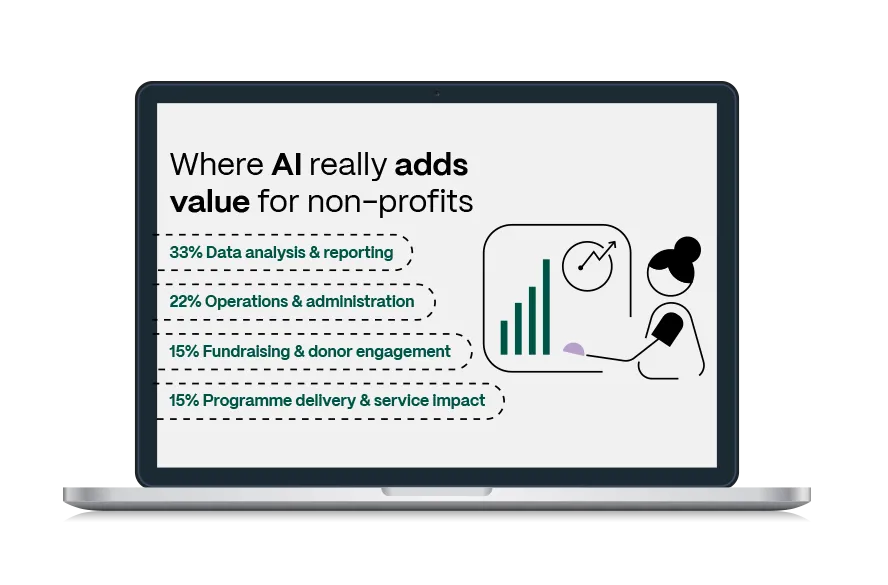
Download our free infographic
AI is already on the agenda for non-profits. Readiness isn’t. We surveyed the sector to understand where AI creates real value, and what’s holding organisations back. Download the infographic.
How non-profits really see AI: Expectations, barriers and readiness
Thank you for downloading our infographic. You can find the document in your downloads. :)


3. Fewer spreadsheets, clearer decisions
For many years, data in non-profit organisations was collected primarily for reporting to satisfy funders, donors, and administrative requirements, rather than to support day-to-day decision-making.
That is starting to change. In 2025 and 2026, non-profits are increasingly using data operationally, to understand what is working, where pressure is building, and which actions will have the greatest impact. The emphasis is shifting from maintaining spreadsheets to gaining clear, usable insight.
Instead of trying to capture everything, organisations are becoming more selective. The focus is on smaller sets of information that are reliable and relevant, asking better questions rather than generating more data.
Poor or incomplete data quickly undermines this effort. When teams don’t trust the numbers in front of them, decisions slow down and manual workarounds return, eroding any potential benefit in already stretched organisations.
By 2026, effective use of data is less about dashboards or volume, and more about enabling confident decisions, faster action, and a sustained focus on outcomes rather than administration.
4. Security and transparency are no longer optional
By 2026, expectations around security and transparency in the non-profit sector have risen sharply. Donors expect clear, verifiable insight into how funds are used, regulation is more demanding, and public trust is increasingly fragile. In this environment, security has become a core part of organisational credibility, not a technical afterthought.
In practice, the biggest risks rarely come from missing tools, but from how work actually gets done. I have seen security controls gradually weakened by “temporary” workarounds: shared logins, manual data exports, files stored outside core systems, introduced to keep services running under pressure, and then quietly becoming permanent.
This is why security in non-profits is as much an organisational challenge as a technical one. When ownership is unclear or processes are inconsistent, even well-designed systems fail to protect data, people, and trust.
At the same time, effective security must support the mission rather than slow it down. Approaches that balance protection with usability help teams work confidently, avoid unsafe shortcuts, and maintain transparency through consistent, responsible practice.
5. Non-profits are looking for partners, not vendors
By 2026, non-profit organisations are less interested in acquiring “another tool” and far more focused on finding partners who understand their reality.
Non-profits operate under constraints that differ significantly from commercial organisations: limited budgets, small teams, complex governance, and constant pressure to prioritise mission delivery over internal investment. When technology decisions are made without this context, solutions are often difficult to adopt, expensive to sustain, or misaligned with how teams actually work.
In one recent partnership, the most important work happened before any technical decisions were made. Time spent understanding the organisation’s mission, pressures, and everyday workflows shaped the direction of the work far more than any predefined solution could have.
What stood out was that progress came not from moving fast, but from slowing down early. Grounding decisions in real constraints and real people led to technology choices that were more focused, more ethical, and more sustainable.
This is increasingly what non-profits value in 2026. They are looking for partners who invest time in understanding context before proposing answers, who adapt rather than impose, and who recognise that technology decisions in this sector are inseparable from trust, responsibility, and long-term impact.
In this environment, successful technology work is less about selling solutions and more about earning the right to build them.
A more practical path forward
By 2026, non-profit technology is no longer about keeping up. It is about making deliberate choices under real constraints.
The organisations moving forward are not those adopting the most tools, but those simplifying what they already have, protecting trust, and designing technology around how people actually work. AI may play a role, but it cannot replace clear foundations, sound judgement, or human connection.
Progress in the non-profit sector is increasingly defined by restraint rather than ambition by choosing what not to build, automate, or buy. In that discipline lies the difference between technology that looks impressive and technology that quietly sustains impact.
Ultimately, the strongest technology outcomes emerge when technology listens before it leads, aligning with organisational priorities and supporting people, rather than forcing change for its own sake.