
From shoppers to AI agents: How retail customer engagement is being redefined
The shift from human-driven to agentic commerce

Agentic AI is redefining the fundamentals of e-commerce. Instead of consumers manually navigating websites, comparing items, and completing transactions, autonomous AI agents now execute the entire buying journey end-to-end: predicting needs, evaluating alternatives, assembling baskets, and checking out on behalf of users.
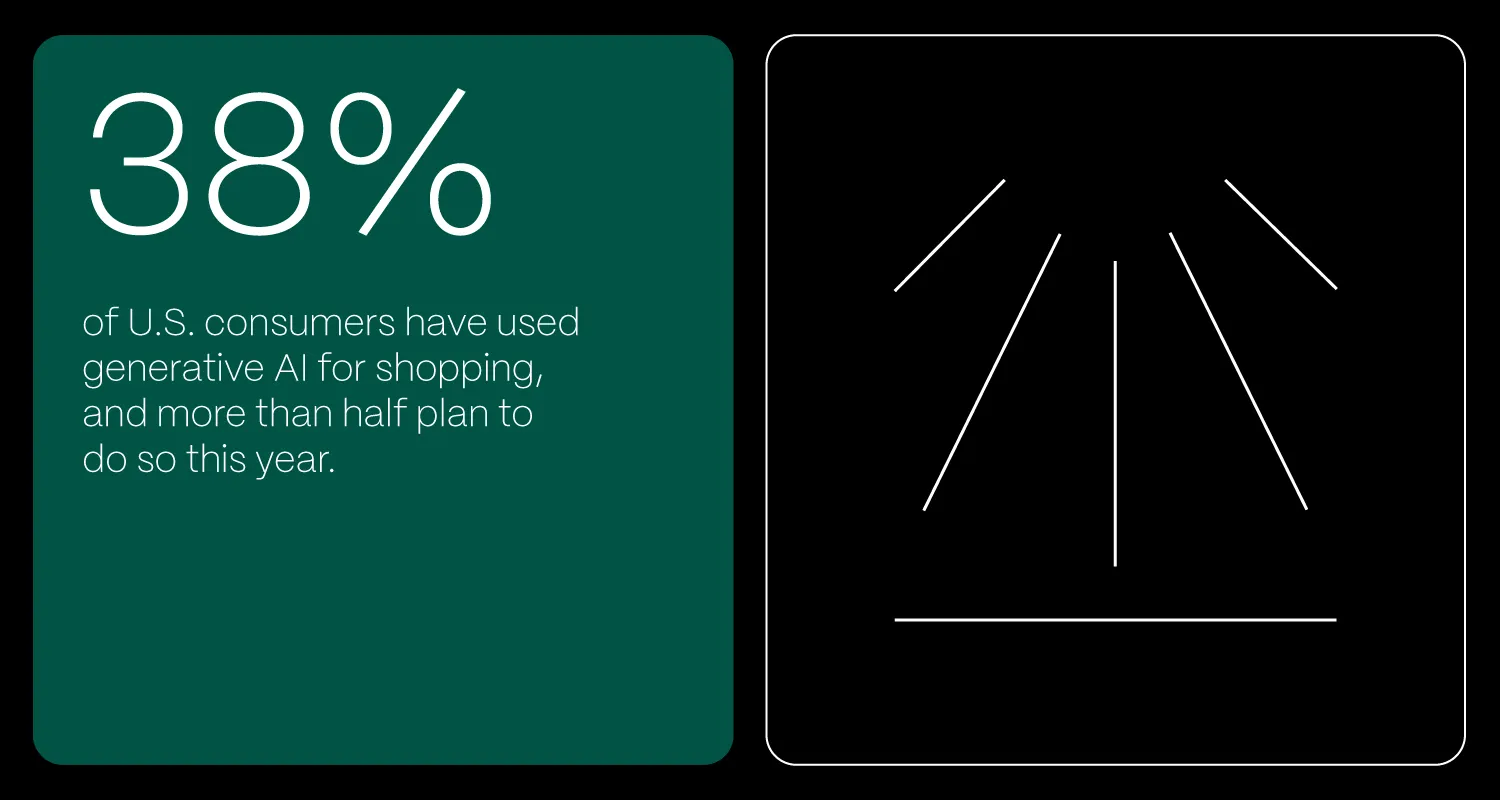
This shift is already visible in consumer behaviour. 38% of U.S. consumers have used generative AI for shopping, and more than half plan to do so this year. As buying decisions become increasingly machine-mediated, retailers must understand how these agents shape discovery and influence demand across digital channels.
When the agent becomes the customer
Agentic commerce reverses the traditional consumer journey. The “customer” interacting with your brand is no longer a human navigating pages, but an autonomous agent acting on their behalf. These systems reorder everyday items, assemble outfits across brands, negotiate delivery terms, optimise budgets, and manage complex replenishment flows without a person ever visiting a website.
For example, a shopper might ask an agent to “find a waterproof jacket under £120, deliverable by Friday”. The agent can compare options across brands, check real-time availability and delivery constraints, apply preferences, and complete checkout, without the customer browsing multiple sites or managing the purchase steps manually.
As algorithms increasingly mediate discovery, comparison, loyalty, and conversion, retailers must rethink how they structure product data, expose information, and communicate value in environments where AI, not humans, makes the decisions.
The business model imperative also shifts from optimising clicks to earning agent trust. Retailers must evolve away from monetisation models built on user traffic and advertising exposure, towards models where they act as gatekeepers of consumer intent and execution reliability.
What AI agents already do in retail today
Agent-driven interactions are no longer experimental. AI agents are already handling concrete parts of the retail journey, from product discovery and comparison to replenishment, post-purchase support, and B2B procurement:
- Personal shopping agents: gift finders, trip planners, outfit builders, back-to-school kits.
- Replenishment agents: groceries, household essentials, beauty, pharma, pet supplies.
- Price-optimisation agents: real-time comparisons, discount stacking, delivery optimisation.
- Post-purchase agents: returns, warranty handling, delivery modifications, subscription management.
- B2B procurement agents: automated reordering, inventory balancing, assortment recommendations.
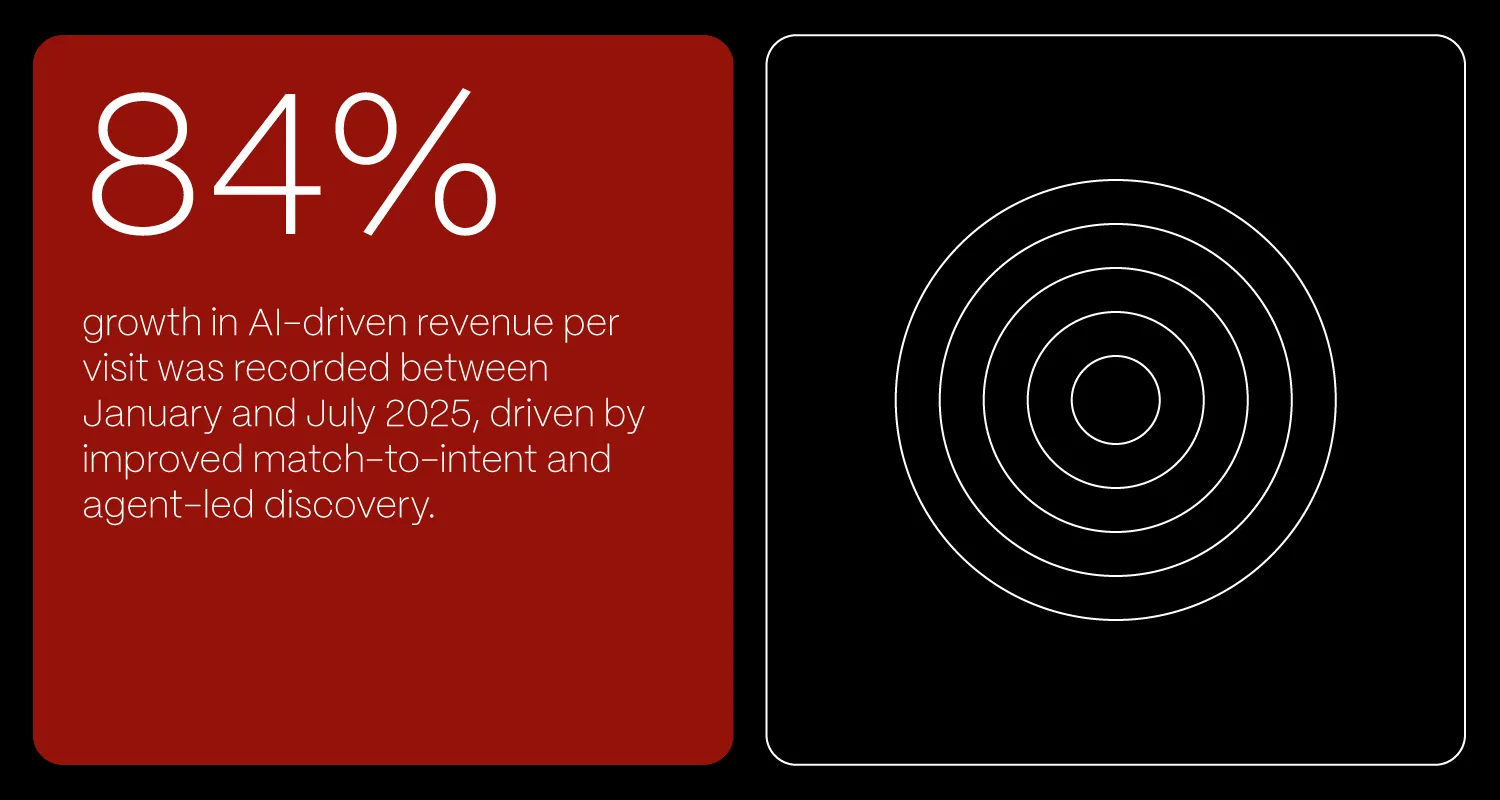
The impact is material. Between January and July 2025, AI-driven revenue-per-visit increased by 84%, driven by improved match-to-intent and agent-led discovery.
Across industries, generative AI initiatives deliver an average return on investment of 1.7×, reinforcing the business case for agentic capabilities.
Taken together, these signals are pushing retailers to move from isolated experimentation towards building the foundational capabilities required for agent-driven commerce.
Architecting an AI-agent commerce world
To succeed in an agentic ecosystem, retailers must move from experimentation to foundational readiness across four dimensions:
1. Trust, governance and data quality
Agentic adoption depends on confidence from users as well as from the agents acting on their behalf. Retailers need:
- transparent data practices and explicit consent for agent-led purchases
- strong privacy, governance, and compliance frameworks
- attribute-rich product catalogues with structured metadata
- real-time accuracy in pricing, stock levels, and fulfilment
- Retrieval-Augmented Generation (RAG) grounds AI responses in trusted, real-time sources such as product catalogues and knowledge bases, reducing hallucinations and ensuring that agent decisions are based on accurate, up-to-date data.
In practice, this means an agent can confirm that a specific item is in stock in the right size, priced correctly, and eligible for next-day delivery before adding it to the basket on the customer’s behalf.
High-quality, machine-readable data becomes the new “shelf placement” that determines visibility.
2. Technical enablement and emerging protocols
Agentic commerce relies on secure, interoperable, machine-friendly interfaces. Rather than individual tools, what matters is a shared set of standards that allow agents to access product data, coordinate actions, and complete transactions reliably.
Several emerging standards are shaping this ecosystem, including protocols for model context access, agent-to-agent communication, payments, and agent-led commerce workflows.
The specifics matter less than the overarching shift: retailers must expose clean data and stable interfaces that agents can interpret and act upon reliably.
3. High-impact retail use cases
While agentic commerce spans many potential applications, only a small number of use cases consistently deliver immediate operational and commercial value in retail.
- Autonomous inventory reordering: reducing stockouts and overstock
- Dynamic pricing: real-time margin optimisation in machine-to-machine environments
- Generative Experience Optimisation (GXO): replacing traditional SEO with structured, semantic, fact-based content that AI agents can reliably interpret and trust
- Agent-ready product experiences: exclusive bundles and value-adds that resist pure price comparison
4. Talent and operating model transformation
Agentic commerce requires new skills across AI/ML, data engineering, UX, and legal/compliance. Retailers must reskill teams, realign workflows, and shift towards continuous adaptation over one-off implementations.
Where agentic commerce can hurt retailers
Agentic commerce brings efficiency, but it also introduces systemic risks retailers must anticipate:
1. Loss of the direct customer relationship – AI agents become intermediaries, reducing human interaction with brands. Emotional storytelling, differentiation, and discovery diminish as agents optimise for functional value.
Mitigation: deploy branded shopping agents, strengthen loyalty programmes, and design post-purchase experiences external agents cannot replicate.
2. Margin compression and hyper-rational buying – agents eliminate impulse purchases and emotional premiums. Price comparisons intensify, promotions are exploited instantly, and premium brands risk commoditisation.
Mitigation: strengthen supply-chain efficiency, adopt dynamic pricing engines, invest in private-label ranges, and develop bundles that resist simple price matching.
3. Decline of traditional marketing effectiveness – SEO, influencer marketing, and email nurturing lose influence when agents, instead of humans, conduct discovery.
Platforms like Amazon’s Rufus, Walmart’s Sparky, and Salesforce’s Agentforce are rolling out AI-driven tools designed to boost customer experiences and conversions, reducing reliance on traditional, human-oriented marketing touchpoints.
Mitigation: prioritise first-party data, structured product feeds, detailed metadata, and content optimised for agent ranking criteria.
4. Data quality, de-ranking risk and platform dependency – agents punish poor data instantly. Incorrect stock levels, slow APIs, mismatched attributes, or inconsistent pricing can reduce visibility in agent-driven rankings.
Because agents optimise for efficiency, purchases may increasingly concentrate around the cheapest, fastest-to-ship, best-rated options, limiting exposure for niche or emerging brands and creating winner-takes-most dynamics similar to the evolution of SEO.
Platform dependency is also rising as ecosystems introduce proprietary APIs, participation requirements, and compliance rules.
Mitigation: enforce strict catalogue governance, real-time synchronisation, high-availability APIs, automated error detection, and multi-platform participation.
The role of a retail software partner in the agentic transition
These risks underline why execution matters as much as strategy in agentic commerce.
As agentic commerce reshapes retail, many organisations struggle to move from high-level intent to practical implementation. What is often missing is not vision, but a structured way to assess readiness, prioritise use cases, and scale agentic capabilities without introducing operational risk.
A retail software development partner helps bridge this gap by supporting retailers across a small number of tightly connected phases:
- Strategy and readiness – defining where to start and which use cases to prioritise
- Data and architecture enablement – preparing reliable data foundations for agentic systems
- Agent engineering and integration – connecting task-specific agents across core platforms
- Experience redesign – adapting customer journeys to agent-mediated interactions
- From pilot to scale – validating value before broad rollout
- Operational continuity – ensuring stability and continuous optimisation over time
The bottom line
Agentic commerce is no longer a future scenario, it is actively reshaping how consumers discover, evaluate, and purchase products. Buying decisions are becoming increasingly machine-mediated, and the retailers who succeed will be those who build the data, governance, and technical foundations needed to work with, and influence, autonomous AI agents.
The competitor you must outperform tomorrow may not be a human shopper, but the agent making decisions on their behalf.