
What we learned about broker-carrier connectivity at Send's Infuse webinar
The insurance industry has spent the last several years digitising submissions, automating workflows, and experimenting with AI across underwriting. Yet as the market softens, a familiar tension is resurfacing: how much of this business can technology actually own, and how much still depends on the relationship between a broker and a carrier.
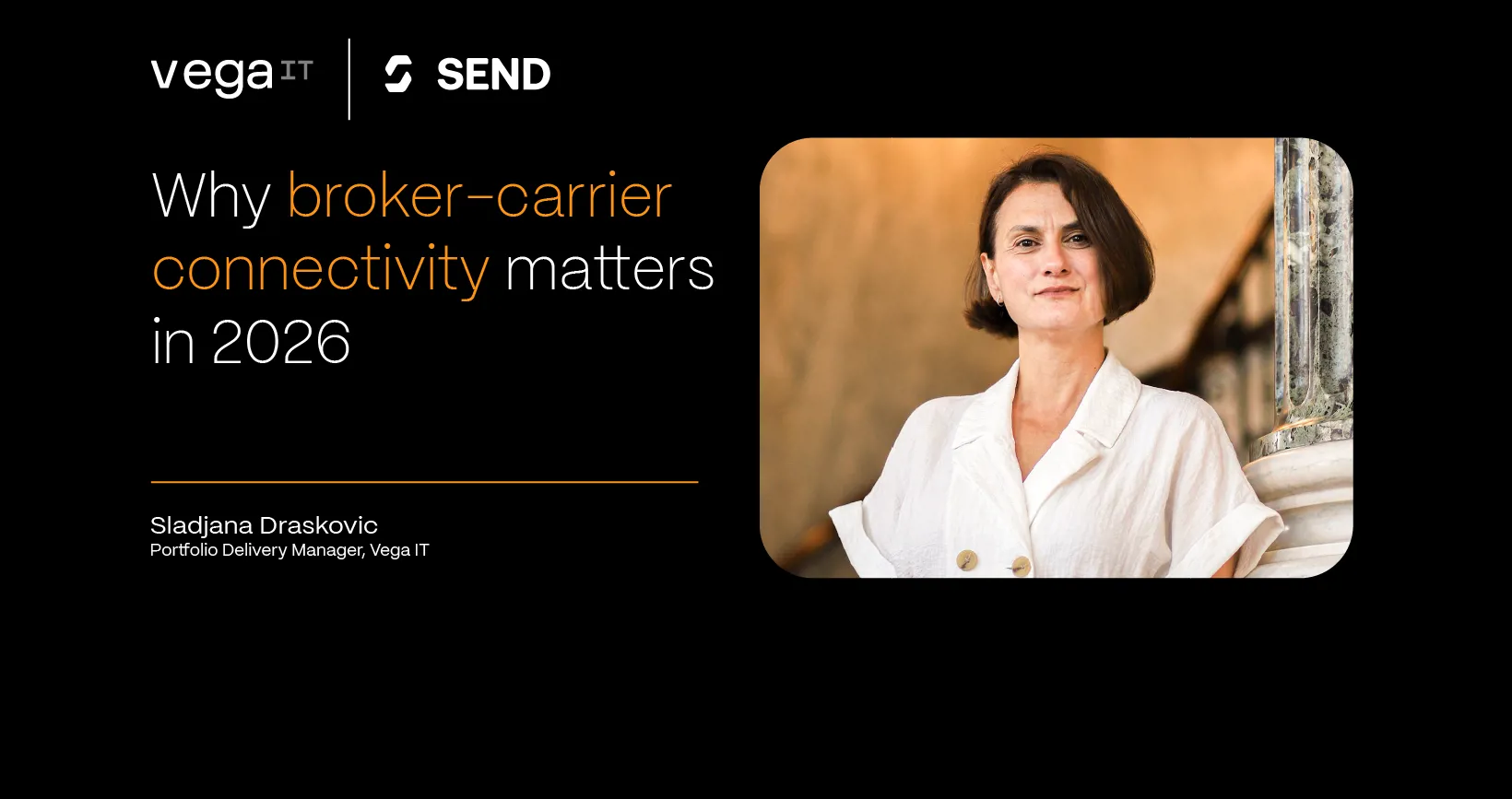
It was one of several topics covered at Infuse September 2026, a webinar hosted by Send. We joined the discussion alongside James Martin, Global Enterprise Director and Head of Brokers at AXA, and Kevin Smith, Senior Vice President at Relation Insurance Services, hosted by Tony Tarquini. Representing Vega IT on the panel was Sladjana Draskovic, our Portfolio Delivery Manager.
Across the discussion, one idea kept resurfacing: connectivity in insurance is both a data problem and a human one, and solving only the first doesn't get you very far.
Trust is the product, technology is the toolkit
Insurance, at its core, is built on a promise to pay, and that promise depends on trust between brokers and carriers. No amount of automation changes that foundation. What it can change is how much time people have to actually invest in it.
Technology is not here to replace humans, but it is here to be built around what the customers need, what the business needs. And it's there to remove the friction and also help both brokers and underwriters spend more time building relationships, and take over the more mundane, chore-like activities.
The flip side is that this works both ways: get the technology wrong, and it can erode trust far faster than good technology ever builds it.
A softer market raises the bar on service
A softening market doesn't lower client expectations, it raises them. With capital more readily available, price alone stops being a meaningful differentiator, and clients start judging carriers and brokers on speed, clarity, and the quality of advice they receive.
The panel pointed to a specific shift in what "good service" now requires: faster turnaround on submissions, decision support rather than raw data, and advisors who arrive prepared rather than reactive. Tools that help teams prepare exposures, triage inbound documents, and streamline quoting were cited as concrete ways technology is already "buying back time" for people to spend on advisory work instead of admin.
Most delivery failures start with a misunderstood problem
The panel's conclusion was that failed technology projects usually trace back to the same root cause: a gap between what developers build and what end-users actually need. Brokers and account managers are rarely given the time to properly shape a new system's requirements before it ships, and the result is technology that looks impressive but doesn't get adopted.
Two examples from Kevin Smith confirmed exactly that: a quoting platform that looked impressive but required brokers and carriers to log into yet another system, so it never got used the way it was intended; and a broker interface whose APIs hadn't been properly vetted with each individual carrier, leaving auto-quote rates far lower than expected until the underlying subjectivity requirements were reworked.
One lesson we could take from the session: carriers need to invest as heavily in upskilling their people as they do in the tools themselves, technology only pays off if the teams using it know how to get the most from it.
Speed is a feature, not a shortcut
None of this means transformation should move recklessly. Pilots and proofs of concept remain essential, and they take time to test, retest, and refine properly. What the panel pushed back on was the traditional pace at which insurance has historically made those decisions.
The concern is less about skipping diligence and more about timing: by the time a lengthy, traditional pilot process concludes, the underlying technology has often moved on, and the opportunity with it. The panel's shared view was that the industry needs to find ways to test and adopt faster without sacrificing the care that regulated, high-stakes decisions require.
Data first, AI and automation second
If there was one technical thread running through the session, it was this: AI and automation are only as good as the data feeding them. Submissions that arrive as unstructured, inconsistently formatted documents create exactly the kind of manual, error-prone re-keying that connectivity is supposed to eliminate.
Sladjana described the fix as building submission APIs that act as a structured bridge between systems, checking not just that data exists, but that it belongs where it's going.
Think of it almost as a bouncer at the front door of an exclusive VIP club. It doesn't just check your ID, it checks if you're on the list for the VIP section.
Once that foundation of structured, validated data is in place, AI has something worth working with, applied to specific problems like sanctions checks, submission classification, or document extraction from bordereaux and endorsements, rather than deployed as a general-purpose fix. As Sladjana put it, "if you put rubbish data in, you're just making bad decisions faster." The goal isn't to replace decisions, it's to help people make better ones, more quickly.
From automating tasks to orchestrating workflows
The panel's broader point was that the industry is shifting focus from automating individual tasks to redesigning workflows end-to-end. Customers want fewer handoffs, clearer decision points, and processes that behave consistently across underwriting, operations, and technology, not a patchwork of automated steps stitched together after the fact.
Done well, automation removes friction rather than people, freeing underwriters to spend more time exactly where their expertise matters most: in conversation with brokers.
Key takeaways
The panel's overarching message was less about choosing between technology and relationships, and more about sequencing them correctly. Understand the client's actual problem first, invest in the people who will use the technology, and move with more urgency than the industry has historically allowed itself, without losing the trust that the whole business depends on.
Asked to leave the audience with one thing to remember, each panelist kept their answer short. James Martin pointed to clients' needs, upskilling the people, and technology paired with trust-based relationships. Kevin Smith urged carriers and brokers to simply engage with the available tools rather than waiting them out, arguing they'll grow the industry rather than shrink it. And Sladjana's closing line captured the session's throughline in a single sentence: "Automation driven by business outcomes. AI, practical, workflow-specific - not hype."
It's a fitting summary of where the market is headed: not toward less connection between brokers and carriers, but toward connection built on cleaner data, sharper tools, and the relationships that were never really up for automation in the first place.
Thank you to Send for hosting Infuse webinar once again, and for having our Sladjana on the panel.